
Common Medical English Terminology Professionals Should Know

What Is Medical English?
Medical English is the English used in healthcare settings: with patients, with colleagues, in handovers, in exams and in research. It is not simply general English with a few extra words. It has its own vocabulary, its own pronunciation challenges and its own habits of register, such as when to say "myocardial infarction" and when to say "heart attack".
Many healthcare professionals already know a lot of this language on paper. The harder part is saying it clearly and hearing it correctly when someone is speaking quickly.
The Word Parts That Build Most Medical Terms
The good news is that most medical terms are built from a small set of repeating parts. Learn the parts and you can often decode a word you have never seen.
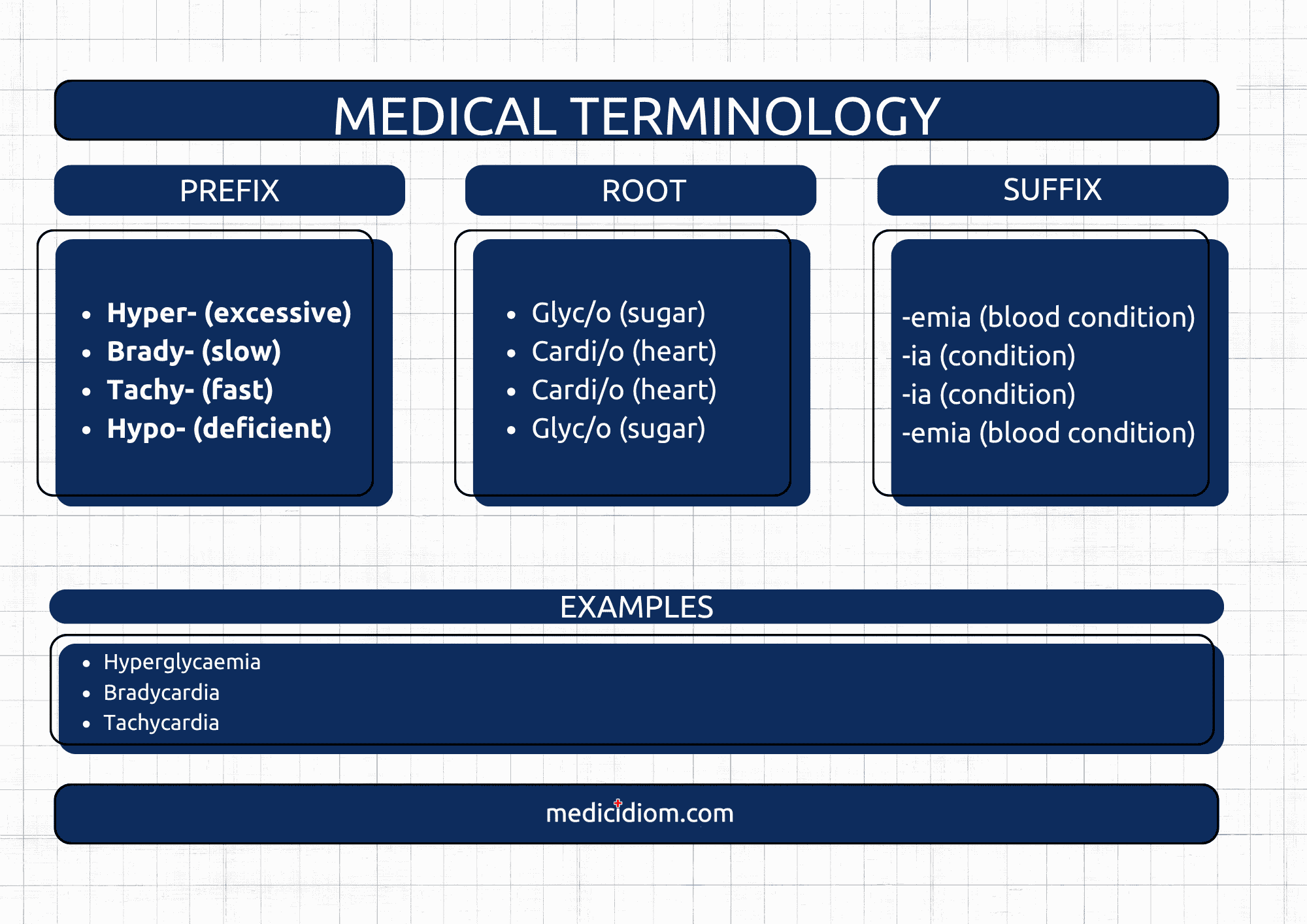
Most terms combine three types of building blocks:
- Prefixes at the start, such as hyper- (above or excessive), hypo- (below or deficient), peri- (around) and brady- (slow).
- Roots in the middle, such as cardi- (heart), gastr- (stomach), hepat- (liver) and nephr- (kidney).
- Suffixes at the end, such as -itis (inflammation), -ectomy (surgical removal), -ology (the study of) and -emia (a condition of the blood).
Put them together and the meaning appears. Gastr plus itis gives gastritis, inflammation of the stomach lining. Hyper plus glyc plus emia gives hyperglycaemia, too much sugar in the blood.
Many of these parts come from Greek and Latin, so Spanish speakers often recognise them quickly. The challenge is usually not meaning but pronunciation, because the stress and vowel sounds in English can be very different.
Common Medical English Terminology, 10 Words Every Professional Should Know
Below are ten words that come up constantly in clinical conversations and that are often pronounced differently from how they are written. You can practice how to pronounce each of these words using Medicidiom´s Live Call feature.
1. Symptom
/ˈsɪmp.təm/ (SIMP-tum) What a patient reports or feels. Note that the p is pronounced, and the final syllable is a weak "tum", not "tome".
2. Diagnosis
/ˌdaɪ.əɡˈnoʊ.sɪs/ (dy-ug-NOH-sis) The identification of a condition. The main stress falls on the third syllable, "NOH".
3. Prognosis
/prɑːɡˈnoʊ.sɪs/ (prog-NOH-sis) The likely course of a condition. It shares its stress pattern with diagnosis, so practise them as a pair.
4. Chronic
/ˈkrɑː.nɪk/ (KRON-ik) Long-lasting. The ch is a "k" sound, not "ch" as in "chair".
5. Acute
/əˈkjuːt/ (uh-KYOOT) Sudden or severe in onset. Stress falls on the second syllable.
6. Benign
/bɪˈnaɪn/ (bi-NINE) Not harmful or not cancerous. The ending rhymes with "nine".
7. Inflammation
/ˌɪn.fləˈmeɪ.ʃən/ (in-fluh-MAY-shun) The body's response to injury or infection. The stress is on "MAY", and the ending is "shun".
8. Hypertension
/ˌhaɪ.pərˈtɛn.ʃən/ (hy-per-TEN-shun) High blood pressure. Notice the prefix hyper- is pronounced "hy-per", not "hee-per".
9. Abdomen
/ˈæb.də.mən/ (AB-duh-mun) The belly area. The stress is on the first syllable, which surprises many learners.
10. Severe
/sɪˈvɪr/ (suh-VEER) Very serious or intense. It has two syllables, with the stress on the second, and it does not end in "-er" like "sever".
False Friends: Where Spanish and English Look Alike But Mean Different Things.
Because English and Spanish share so much Latin vocabulary, many words look familiar but do not mean the same thing. These are called false friends, or false cognates. They are tricky because the sentence is grammatical, so nothing signals to the listener that the meaning has gone wrong. Here are a few worth knowing in a clinical setting:
| Spanish Term | Sounds/Looks Like (English) | Actual Meaning in English | Correct Spanish Translation for the English Word |
|---|---|---|---|
| Constipado | Constipated | Having bowel difficulty (estreñido) | Estreñido |
| Intoxicado | Intoxicated | Drunk or under the influence of drugs | Borracho / bajo los efectos del alcohol |
| Molestia | Molestation | Sexual abuse (abuso sexual) | Abuso / agresión sexual |
| Sanidad | Sanity | Mental soundness or cordura | Cordura / salud mental |
| Actual | Actual | Real or true (real) | Real / verdadero |
A good habit is to pause when a word feels suspiciously easy. If it looks almost identical in both languages, check it.
How to Practice These Terms So They Stick
Reading a list is a good start, but spoken language needs spoken practice. A few simple habits help:
- Listen, then speak. Play the audio, pause, and say the word aloud before checking yourself.
- Practice in pairs. Words like diagnosis and prognosis share a rhythm, so learning them together reinforces both.
- Use the words in a sentence. Try "The patient has a chronic condition" instead of repeating the word alone.
- Revisit little and often. Two minutes a day on a handful of terms is easier to keep up than a long weekly session. Furthermore, you can gamify your English learning process, making the learning a fun and challenging experience.
Moving From Knowing the Words to Using Them
Knowing a term and using it clearly under time pressure are different skills. Most healthcare professionals do not need more vocabulary lists. They need more chances to hear and say the language in realistic situations, and to get feedback on what to adjust.
A medical English learning app with interactive exercises can help with exactly that. Dr.SpeakBetter, from Medicidiom, offers medical English speaking and listening practice designed around healthcare contexts and the errors clinicians actually make, so you can rehearse the words in this post and many more at your own pace. If you would like to try saying these ten terms aloud and hearing how they sound, explore more HERE.
Whichever way you practice, the aim is the same: to communicate clearly when the moment matters.